
A striking statistic shows that 76% of consumers who search for a local business on their smartphones visit one within a day. The choice between local and global SEO isn’t just academic theory – it directly affects your business growth.
Local SEO connects you with customers seeking immediate solutions in your area, typically with high purchase intent. Global SEO serves businesses that want to reach an international audience. Strategy and scope separate local SEO from broader SEO efforts. Your local SEO efforts focus on specific geographical areas, while national SEO tactics reach across regions or countries.
Your business model should drive the choice between these approaches. Small companies can dominate their local market through local SEO, while businesses selling nationally or internationally need global SEO techniques. Choosing between local and national SEO requires careful consideration. Understanding both strategies helps you allocate your marketing budget effectively.
This piece examines both approaches to help you select the right fit for your business goals. You’ll discover essential details about target audiences, keyword strategies, technical needs, and practical tools. These insights will give you a clear direction for your SEO strategy.
Understanding the Core: What is Local SEO vs Global SEO?
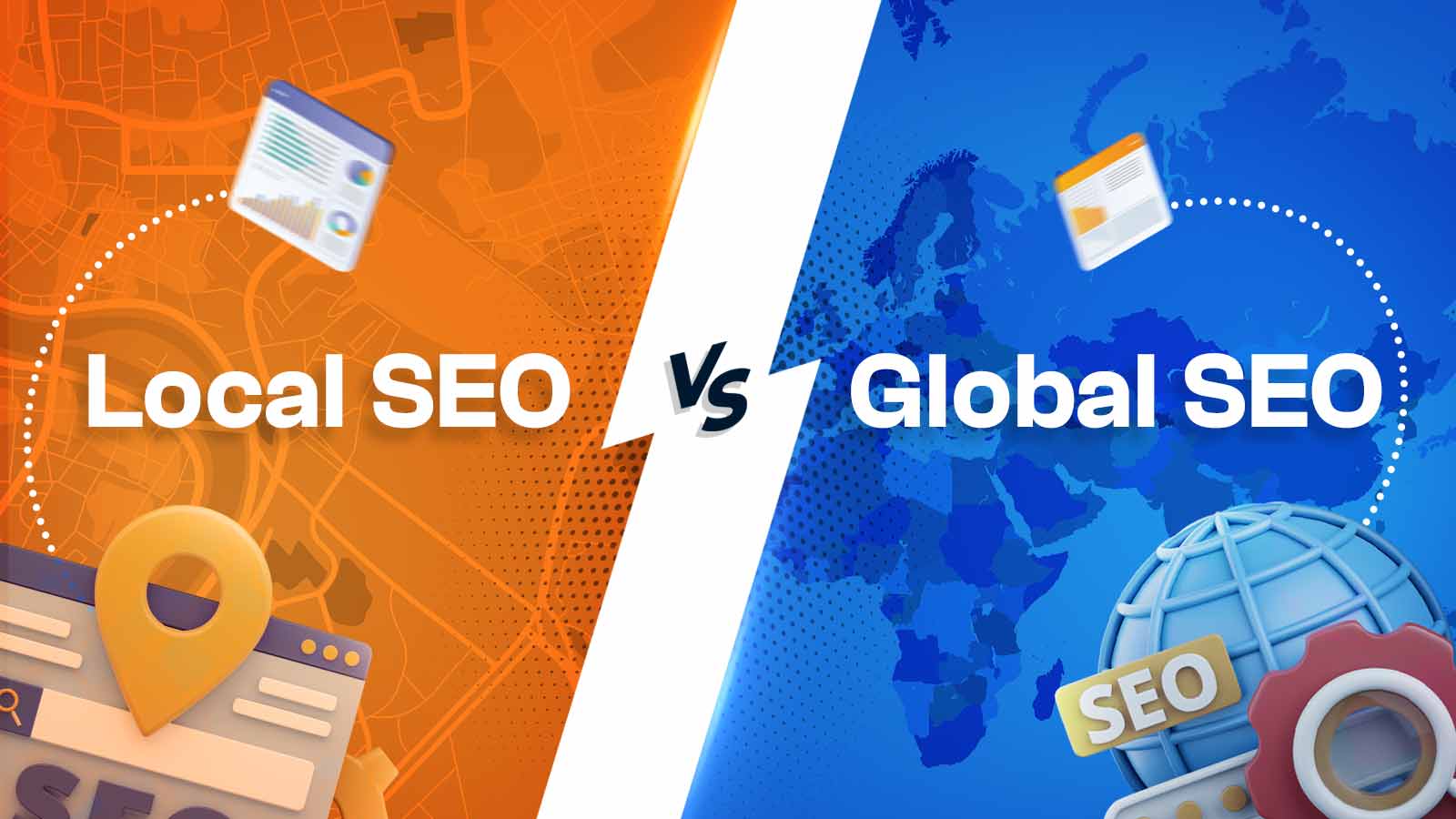
Businesses face a crucial choice between two different SEO strategies as they compete for online visibility. The difference between local SEO vs global SEO shapes how businesses connect with potential customers and the technical approaches they need.
Definition and goals of local SEO
Local SEO optimizes a business’s online presence to attract nearby customers. This targeted strategy helps users find local products or services through searches with phrases like “near me” or specific city names. The main goal aims to improve visibility in location-based results on Google Search, Google Maps, and other search engines.
A soaring win in local SEO depends on several essential components. Google Business Profile (formerly Google My Business) lets businesses manage their Google presence and give customers vital information. Consistent local citations – business name, address, and phone number (NAP) – across websites build credibility. Positive customer reviews provide social proof and boost local search visibility.
The numbers tell a compelling story: 46% of all Google searches look for local information. About 76% of people visit a physical store within 24 hours after a local search.
Definition and goals of global SEO
Global SEO (or international SEO) helps websites rank higher in search results across countries and languages. This strategy breaks down geographical barriers and reaches worldwide customers through language-specific optimization, cultural adaptation, and regional search engine tactics.
Global SEO needs more complex technical elements:
- Hreflang tags show search engines the target language/region for each page
- Market-specific URL structures (like .uk, .de domains)
- Content that appeals to different cultures and languages
Global SEO goes beyond translation. Businesses must localize content, adapt to regional priorities, and understand unique search behaviors in each market. This strategy aims to boost global visibility, enhance international user experience, and grow revenue by connecting with customers worldwide.
Difference between local SEO and SEO at large
These strategies differ mainly in their geographic focus. Local SEO targets searches in specific areas, while national or global SEO reaches broader audiences without location limits.
The strategies differ in several ways:
- Target audience: Local SEO reaches nearby customers ready to buy, while global SEO connects with a broader audience that needs more nurturing.
- Keyword strategy: Local SEO uses location-specific keywords like “best Italian restaurant in downtown Seattle.” Global SEO targets broader terms without locations.
- Search result goals: Local SEO targets the “local pack” or “map pack” – three business listings with a map that get about 33% of all clicks for local searches. Traditional SEO focuses on standard organic listings.
- Technical requirements: Local SEO relies on Google Business Profile, citations, and reviews. Global SEO needs hreflang tags, specific domains, and multilingual content strategies.
Many businesses benefit from a hybrid approach that blends both local and global SEO to maximize their online visibility.
Target Audience and Business Fit
Your business model determines the right SEO strategy. The difference between local and global approaches goes beyond geography – it connects you with ideal customers wherever they search.
Local SEO: Best for brick-and-mortar and service-based businesses
Local SEO strategies help brick-and-mortar businesses thrive. Physical stores can boost their visibility in specific areas through this approach. A retail shop, restaurant, or local service business can turn online searches into store visits and build a stronger physical presence. Research shows that 60% of smartphone users reach out to businesses directly through local search results.
Service-area businesses (SABs) can reap the benefits of local SEO without having a storefront.
These include:
- Plumbers, electricians, and HVAC providers
- Mobile pet groomers and cleaning services
- Locksmiths and pest control professionals
- House painting businesses
Local SEO helps service businesses clearly define their coverage radius to potential customers. You can use Google Business Profile by setting service areas instead of showing a street address, even without a physical location. These businesses can reach broader geographic areas compared to single-location stores.
Local SEO brings in high-intent traffic – people who search locally often want immediate solutions and convert faster. 78% of mobile local searches lead to in-store purchases.
Global SEO: Ideal for ecommerce and digital-first brands
E-commerce and digital-first brands naturally align with global SEO strategies. These businesses can reach worldwide customers through well-optimized websites without geographic limits. Global SEO eliminates borders by focusing on multilingual content, cultural adaptation, and regional search engine priorities.
Digital-first companies can use broader keyword strategies without location qualifiers. They target terms like “best online pizza delivery” instead of “best pizza in Chicago” to serve wider audiences. This method requires knowledge of market behaviors, cultural nuances, and search patterns.
International e-commerce SEO needs thorough market research for each target country. Your success depends on understanding how your audience’s preferred search engines work – Google leads in the US, while South Korea uses Naver, China prefers Baidu, and Russia favors Yandex. Region-specific language, currencies, and cultural references play a vital role beyond basic translation.
National SEO vs Local SEO: Where does your business fall?
Many businesses operate between hyperlocal and global markets. National SEO targets country-wide audiences without focusing on specific locations. This strategy suits businesses that sell nationwide but not internationally.
Your SEO approach should account for these factors:
Your customer base comes first. Do customers visit your store in person or order products from anywhere? The national SEO model fits businesses that serve customers across state lines without international shipping.
Growth goals matter too. Start with local SEO if you want to dominate your city first. National SEO might work better if you have broader initial plans.
Competition levels need review. National SEO faces more competitors than local strategies. Targeting national audiences means competing with hundreds of similar businesses instead of a few local ones.
Businesses with physical locations and online stores often need hybrid strategies. This “phygital” approach combines local SEO for store visits with broader techniques for online sales. Your business priorities and resources determine the right mix.
Keyword Strategy and Content Focus
Keyword research is the bedrock of any successful SEO campaign. Your approach to finding and using the right search terms changes based on whether you choose local or global strategies.
Local SEO: Geo-targeted long-tail keywords
Local SEO runs on geo-targeted keywords that pair service terms with location modifiers. These specific phrases help nearby customers find immediate solutions. A local business would target “organic coffee shop near downtown Phoenix” rather than just “coffee shop”.
Location-specific modifiers boost your business visibility in three vital ways:
- City and neighborhood names (“best plumber in Chicago”)
- Local landmarks (“salon near Central Park”)
- “Near me” phrases that trigger location-based results
Long-tail keywords are valuable especially when you have local businesses. Search volumes might be lower, but conversion rates are higher because they reach users further along in their buying experience. Someone looking for “emergency root canal service in Brooklyn” needs help right away.
Voice search has made geo-targeted long-tail phrases more important than ever. Research shows 76% of people use voice search at least weekly to find local businesses. People talk to voice assistants naturally and ask specific questions like “Where can I find the best vegan pizza downtown?”.
Global SEO: Multilingual and intent-based keyword research
Global SEO needs a deep understanding of how search behavior changes across countries and cultures. Translation alone won’t cut it – markets often use completely different terms for identical products or services.
Intent-based keyword research helps us understand what users in different regions want from their searches. Traditional search intent categories – informational, navigational, transactional, and commercial investigation – provide structure, but cultural nuances change how these demonstrate themselves.
Multilingual keyword research starts with analyzing seed keywords in your source language before creating keyword ideas in target languages.
This work includes:
- Identifying which terms can be directly translated
- Finding terms that need cultural adaptation
- Proving keywords have enough search volume in each market
The Festival di Sanremo in Italy creates unique search trends in February. This cultural event affects seemingly unrelated queries. Your global keyword strategy might miss opportunities without this cultural context.
Organic SEO vs Local SEO: How content strategy is different
Organic SEO targets broad, competitive keywords without geographic qualifiers. Local SEO targets location-specific terms to attract nearby traffic. This basic difference shapes how content strategies work.
Content focus changes between these approaches. Local SEO creates content relevant to regional audiences – community events, neighborhood news, or area-specific seasonal tips. Organic SEO develops general content for broader interests, like educational blog posts or how-to guides.
Conversion potential also varies. Local SEO attracts high-intent traffic from users who need something now, leading to faster conversions. About 80% of consumers use search engines to find local information, and 70% of those searches lead to offline visits. Organic SEO usually needs longer conversion funnels and more trust-building content before purchase.
The best results often come from a balanced approach. Local and organic SEO work as complementary strategies that strengthen your online presence.
Technical SEO and Site Structure
Your SEO strategy’s success depends heavily on its technical foundations. Search engines interpret and rank your content based on your website’s infrastructure. This applies whether you target local customers or global markets.
Local SEO: Google Business Profile, schema, and citations
Google Business Profile stands as the life-blood of local SEO success. This free tool helps businesses show up in Google’s Local Pack, Maps, and Search results. Your chances of appearing in relevant local searches increase with accurate and complete business profiles. Search engines and potential customers are more likely to trust companies that have verified, complete profiles.
LocalBusiness schema markup works like a translator between your website and search engines. It gives Google clear information about your business operations, location, and services. Rich results with review stars, business hours, and other attention-grabbing elements appear directly in search results when you add schema. Schema also readies your business to handle voice search queries, which grow more popular each day.
Local citations build your credibility with search engines by mentioning your business name, address, and phone number. These citations exist as structured (business directories) and unstructured (blogs, news sites) mentions. Google ranks local businesses higher when their citations stay consistent, which signals trustworthiness. Directories specific to your industry carry more weight than general business listings.
Global SEO: Hreflang tags, ccTLDs, and subdirectories
Hreflang tags help search engines understand your content’s language and direct users to their preferred language version. You must add these tags to the HTML head section, HTTP headers, or XML sitemaps – but never mix these methods. Each page needs to link to itself and other language versions to create a complete reference loop.
International websites face a choice between country-code top-level domains (ccTLDs) and subdirectories. Search engines receive the strongest geographic signals from ccTLDs (like example.fr), and local users often trust them more. All the same, they need separate domain authority and cost more to maintain. Subdirectories (example.com/fr/) combine SEO authority under one domain but send weaker geographic signals.
Mobile optimization and page speed considerations
Mobile optimization has become essential since over 60% of website traffic comes from mobile devices. Google ranks sites primarily using their mobile versions through mobile-first indexing. Core Web Vitals measure loading performance, interactivity, and visual stability – all factors that affect your rankings.
Page speed plays a crucial role in user experience and search performance. Users abandon slow-loading sites, which increases bounce rates, so pages should load within three seconds. Google PageSpeed Insights points out specific ways to improve your site. You can compress images (50-90% of page size), minify code, and upgrade hosting to fix common issues.
Conversion Potential and User Behavior
Users behave differently when searching for local businesses compared to global ones. These patterns affect your sales numbers and earning possibilities.
Local SEO: High intent, faster conversions
Local searches show clear buying intention. People looking for nearby solutions need help right away. The numbers tell the story – 80% of local searches turn into actual customers. A remarkable 76% of smartphone users visit a store within 24 hours after searching for local businesses.
Take what happens after someone searches for “plumber near me” versus “how to fix leaky pipes.” The local searcher needs immediate help, not just information. This explains why 28% of local searches end in purchases.
Brick-and-mortar businesses see exceptional returns from local SEO. Mobile searches lead to more sales, with 78% resulting in store purchases. About 88% of people who search locally on their smartphones either call or visit the business within a day.
Global SEO: Longer funnels, trust-building required
Global SEO takes more time to generate sales. Without location limits, people often compare options from different regions before making decisions. These research-focused visitors might check your site several times before buying anything.
Trust matters more for global audiences. Local businesses can rely on community connections, but global brands need different ways to build credibility. Quality backlinks from trusted international websites bring visitors who spend more time on your site. These people tend to engage better with your content.
Global SEO needs patience and consistent trust signals. Your content must support prospects through longer buying cycles.
Impact of reviews vs backlinks on conversions
Reviews significantly shape local SEO success. About 97% of consumers say online reviews influence their buying decisions. About 84% of people trust online reviews as much as personal recommendations.
Review quality makes a big difference:
- 92% of consumers choose local businesses with at least a 4-star rating
- 88% of customers prefer businesses that respond to all reviews
- 88% of local searches lead people to businesses that reply to reviews
Backlinks drive global SEO success while reviews power local sales. Quality backlinks create paths that bring motivated international visitors to your site.
Both elements need constant attention – neither works on autopilot. Your SEO strategy should include regular monitoring of traffic, engagement, and sales across each market you target.
Tools and Resources for Each Strategy
Your SEO strategy needs specialized tools that align with your geographic focus. The right software can make complex tasks easier and improve your visibility. Many businesses don’t deal very well with finding the right options.
Local SEO tools: Semrush Local, Moz Local, BrightLocal
Semrush Local has complete features for businesses that target nearby customers. The toolkit manages listings across 150+ global directories and monitors reviews. It also tracks Google Maps rankings with precise location targeting. You can monitor keywords at ZIP code level and track local pack rankings.
Moz Local makes your local SEO work easier through automated listing management. The platform connects your business information to search engines, directories, apps, and data aggregators seamlessly. The optimized review management system combines responses from multiple platforms in one dashboard. Their GeoRank feature displays your business rankings for specific keywords at exact locations.
BrightLocal stands out with location-specific analytics and citation management. The platform tracks keyword positions across Google Search and Maps effectively. Its citation builder maintains your NAP (Name, Address, Phone) consistency – a crucial local ranking factor. BrightLocal’s reputation management suite builds trust by generating and showcasing online reviews.
Global SEO tools: Weglot, Ahrefs, hreflang generators
Weglot makes multilingual SEO easier by handling server-side translation and hreflang tag implementation automatically. The tool translates content in over 110 languages and handles metadata and image alt text translation.
Ahrefs gives you powerful keyword research capabilities for international markets. Keywords Explorer lets you pick target countries for research and shows country-specific data on search volume and difficulty.
Hreflang generators like Aleyda Solis’s tool create tags that help search engines identify language versions of your content. These tools generate the bidirectional linking you need for proper implementation. All equivalent content must link to each other.
Tracking performance: Analytics and rank tracking
Performance tracking just needs tools that monitor both local and global metrics. Google Analytics shows audience-focused metrics like new users, sessions, and average engagement time. Google Search Console helps you understand how Google views your pages through website performance data.
Rank tracking tools like AccuRanker give you on-demand ranking updates accurately. SE Ranking makes shared tools available for agencies with multiple clients. It tracks location-specific rankings across Google, Bing, and YouTube.
Comparison Table
| Aspect | Local SEO | Global SEO |
| Target Audience | Customers in specific geographic areas who need immediate solutions | International audience from multiple countries and languages |
| Best For | • Brick-and-mortar stores • Service-based businesses • Physical locations | • E-commerce businesses • Digital-first brands • International commerce |
| Keyword Focus | • Location-specific terms • “Near me” phrases • City/neighborhood names | • General terms without location qualifiers • Multilingual keywords • Culture-specific terms |
| Technical Requirements | • Google Business Profile • Local citations • LocalBusiness schema markup | • Hreflang tags • ccTLDs/subdirectories • Multilingual content structure |
| Conversion Rate | • 76% visit within 24 hours • 80% of searches convert • Quick conversion cycle | • Extended conversion funnels • Several touchpoints needed • Trust building takes time |
| Tools You Need | • Semrush Local • Moz Local • BrightLocal | • Weglot • Ahrefs • Hreflang generators |
| Search Result Goals | Local pack/map pack gets 33% of clicks | Standard organic listings |
| Trust Signals | Customer reviews and local citations | International backlinks and localized content |
Conclusion
Your business model, target audience, and growth goals will help you decide between local and global SEO. This piece highlights how each strategy benefits different types of businesses.
Local SEO works best for brick-and-mortar stores and service-based businesses. Your physical store can thrive with proper local optimization, as 76% of smartphone searchers visit stores within 24 hours. Service providers also get great results by targeting high-intent customers who need immediate solutions in their area.
E-commerce platforms and digital-first brands should focus on global SEO strategies instead. This approach removes geographical barriers and lets you reach international audiences through multilingual content and cultural adaptations. Global strategies take time because customers usually need multiple touchpoints before they convert.
These approaches have substantially different technical requirements. Local businesses should focus on Google Business Profile optimization, consistent citations, and location-specific schema markup. Global companies need proper hreflang implementation, appropriate domain structures, and content that fits each target market’s culture.
Your keyword strategy must match your chosen approach. Location-specific terms bring local traffic, while broader, culturally-adapted keywords help reach international audiences. Mobile optimization is vital for both strategies, since more than 60% of web traffic comes from mobile devices.
Looking at your business model, customer base, and growth goals might show that a hybrid approach works best. Many successful companies mix elements from both strategies to boost their online visibility and conversion potential.
Note that the right SEO strategy isn’t about following trends but about matching your business goals and customer needs. Your choice between local and global SEO shapes how potential customers find and interact with your brand online. The strategy you pick based on your specific situation will shape your digital success.
Key Takeaways
Understanding the fundamental differences between local and global SEO strategies will help you make the right choice for your business growth and maximize your online visibility.
- Local SEO drives immediate conversions: 76% of smartphone users visit stores within 24 hours of local searches, making it perfect for brick-and-mortar and service businesses.
- Global SEO requires patience but broader reach: E-commerce and digital-first brands benefit from international targeting, though conversion funnels are longer and need more trust-building.
- Technical requirements differ significantly: Local SEO focuses on Google Business Profile and citations, while global SEO demands hreflang tags and multilingual site structures.
- Keyword strategies must match your scope: Use geo-targeted long-tail keywords for local audiences, but implement multilingual and culturally-adapted terms for global markets.
- Hybrid approaches often work best: Many successful businesses combine both strategies to maximize visibility – using local SEO for physical locations while targeting broader audiences online.
The key is aligning your SEO strategy with your business model, customer behavior, and growth objectives rather than following generic best practices.
FAQs
Q1. How does local SEO differ from global SEO? Local SEO focuses on optimizing for specific geographic areas, targeting customers with immediate needs in a particular location. Global SEO, on the other hand, aims to reach a broader international audience across multiple countries and languages.
Q2. Which businesses benefit most from local SEO? Local SEO is ideal for brick-and-mortar stores, service-based businesses, and companies with physical locations. It’s particularly effective for businesses that rely on local customers and want to drive foot traffic to their stores.
Q3. What are the key technical requirements for global SEO? Global SEO requires implementing hreflang tags to specify language and regional targeting, using appropriate domain structures (like ccTLDs or subdirectories), and creating multilingual content that’s culturally relevant to each target market.
Q4. How do conversion rates compare between local and global SEO? Local SEO typically leads to faster conversions, with 76% of local searchers visiting a store within 24 hours. Global SEO often involves longer conversion funnels and requires multiple touchpoints before a purchase, as it targets a broader, international audience.
Q5. What tools are essential for implementing a local SEO strategy? Key tools for local SEO include Semrush Local for comprehensive local search management, Moz Local for automated listing management across directories, and BrightLocal for location-specific analytics and citation management.